Play the tune again: but this time
with more regard for the movement at the source of it
and less attention to time. Time falls
curiously in the course of it.
Play the tune again: not watching
your fingering, but forgetting, letting flow
the sound till it surrounds you. Do not count
or even think. Let go.
Play the tune again: but try to be
nobody, nothing, as though the pace
of the sound were your heart beating, as though
the music were your face.
Play the tune again: It should be easier
to think less every time of the notes, of the measure.
It is all an arrangement of silence. Be silent, and then
play it for your pleasure.
Play the tune again: and this time when it ends,
do not ask me what I think. Feel what is happening
strangely in the room as the sound glooms over
you, me, everything.
Now,
play the tune again.
from 'Weathering' by Alastair Reid.
Wednesday, February 17, 2010
Tuesday, March 17, 2009
A silence more eloquent...
In honor of S and her fam's arrival in town, another reason teachers get mad respect:
Lyrics here.
PS. Everything this choir does is phenomenal.
Lyrics here.
PS. Everything this choir does is phenomenal.

Friday, January 2, 2009
Mighty Aspirations.
"My brother sings to save the good and make the wicked take their own lives. This is the source of his resonance."
- Richard Powers, The Time of Our Singing.
- Richard Powers, The Time of Our Singing.
Thursday, October 9, 2008
At the Post Office.
So this is Part II of "Mundane Errands Rescued by Heroes of Music," a series of indeterminate number.
This time of year for singers is a parody of busy-ness. The entire American opera industry descends on New York from October through early December to hear young blood and old. Back in the day, as a then-unmanaged singer, one found one's self in the post office line at 4:45 more than one would have liked. In these cases, I myself either felt extremely accomplished for having gotten together whatever constellation of elements this or that application required, or cranky and resentful of having to ask (again) for a place at the table.
This time of year for singers is a parody of busy-ness. The entire American opera industry descends on New York from October through early December to hear young blood and old. Back in the day, as a then-unmanaged singer, one found one's self in the post office line at 4:45 more than one would have liked. In these cases, I myself either felt extremely accomplished for having gotten together whatever constellation of elements this or that application required, or cranky and resentful of having to ask (again) for a place at the table.
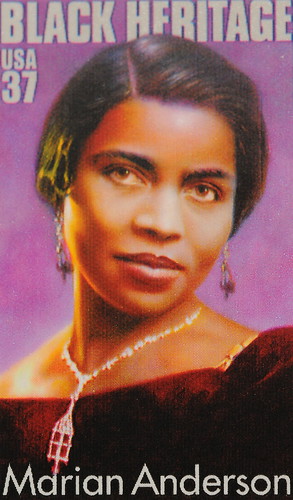
At this time three years ago, I was in the New Haven Post Office on Elm. Even though it's a regular federal post office, Yale- in its modesty- has a permanent display of graduates who've been put on stamps. It fills two walls. You stand in line with your application moving slowly past all these eminences, wondering whether you're on that path to stampdom. Maybe this particular application had required three signed recommendation envelopes and two recordings of arias different than those offered for competition, but cranky and resentful, I glared at the other students in line with applications for jobs that would pay better than music. Then I thought about the marginalization of my industry and thought that no opera singer would ever make it to an American stamp. Then I turned a corner in line and saw a large display of this in all it's purple glory and I forgave all. I thought "What a nice country. What a great artform. What a badass woman."
Wednesday, August 27, 2008
Bernstein on Canal
Today on a Chinatown errand in my role as Girl Who Likes Things “Just So,” my search for a rare ingredient led me down and up Mott and finally into the fishy heart of the large grocery/housewares emporium on Canal. Amid the aisles and aisles of tea dishes and sake sets on the lower floor, I wandered, half looking for the granulated honey I’d come in for and half browsing domestically and thinking that some day between gigs I might use a bamboo dumpling steamer set. These acquisitional imperatives—which alarm me in their insistence that I become my mother— battle with my inner minimalist who in addition to liking the look of all the clean visual lines in dwell, arrives home after seven weeks at Marlboro and looks around her apartment thinking “when did I ever come to needed all this s^%$?!”
In evidence of this struggle, several articles and foodstuffs of Asian origin were chosen, carried around for a while and then put back. As I moved through the wok aisle, I listened to the radio on the megaphone taped to the ceiling and heard that it was playing a synagogue service and I remembered that it was Shabbat. I’m not Jewish, but as a former bread and falafel maker for Oberlin kosher co-op, I sometimes remember these things.
The choir- it sounded like they were two or three on a part- began to sing the last movement of Bernstein's Chichester Psalms with organ. I love Chichester. I sang it for the first time at sixteen when a wonderful and ambitious new choir director used it and Poulenc’s Gloria to announce to the town and the school board that he meant business.
Chichester Psalms is the most Well Meaning of all the very Well Meaning works by Bernstein who in this case had set out to write something academic and twelve-tone and instead wrote something subjective, modal and heart-on-its-sleeve. Parts of it are unbelievably beautiful and moving. The whole thing ends with the opening of Psalm 133 and despite having learned some choice dirty words from naughty Israelis this summer, I won’t try to type the Hebrew, but just the translation: “Behold how good and how pleasant it is for brothers to dwell together in unity.”
The cultural vertigo I felt hearing Bernstein's setting with its super-solemn chords (and its personal meaning for me) crackling down to me from hilariously awful speakers in the housewares section of a Chinese grocer somehow spurred me to take ownership of the whole moment and I thought, “Damnit, I’m going to stand here stock-still among the styro-foam ramen bowls until they get to the chord change I love…” (7:08) So I did. Some shopping NYU students thought me a little wierd, but whatevs. Never found the granulated honey. Didn’t buy a thing. Lenny Bernstein-1/Impulse Shopping-0.
On the way out into the early evening, I passed the live blue fellows below- I wish the picture showed their movement- and wondered whether their "dwelling together in unity" was good and pleasant to them.

In evidence of this struggle, several articles and foodstuffs of Asian origin were chosen, carried around for a while and then put back. As I moved through the wok aisle, I listened to the radio on the megaphone taped to the ceiling and heard that it was playing a synagogue service and I remembered that it was Shabbat. I’m not Jewish, but as a former bread and falafel maker for Oberlin kosher co-op, I sometimes remember these things.
The choir- it sounded like they were two or three on a part- began to sing the last movement of Bernstein's Chichester Psalms with organ. I love Chichester. I sang it for the first time at sixteen when a wonderful and ambitious new choir director used it and Poulenc’s Gloria to announce to the town and the school board that he meant business.
Chichester Psalms is the most Well Meaning of all the very Well Meaning works by Bernstein who in this case had set out to write something academic and twelve-tone and instead wrote something subjective, modal and heart-on-its-sleeve. Parts of it are unbelievably beautiful and moving. The whole thing ends with the opening of Psalm 133 and despite having learned some choice dirty words from naughty Israelis this summer, I won’t try to type the Hebrew, but just the translation: “Behold how good and how pleasant it is for brothers to dwell together in unity.”
The cultural vertigo I felt hearing Bernstein's setting with its super-solemn chords (and its personal meaning for me) crackling down to me from hilariously awful speakers in the housewares section of a Chinese grocer somehow spurred me to take ownership of the whole moment and I thought, “Damnit, I’m going to stand here stock-still among the styro-foam ramen bowls until they get to the chord change I love…” (7:08) So I did. Some shopping NYU students thought me a little wierd, but whatevs. Never found the granulated honey. Didn’t buy a thing. Lenny Bernstein-1/Impulse Shopping-0.
On the way out into the early evening, I passed the live blue fellows below- I wish the picture showed their movement- and wondered whether their "dwelling together in unity" was good and pleasant to them.

Friday, July 25, 2008
Words words words...
 Recently, courtesy of some new friends, I've been overwhelmed with appreciation for the power of non-programatic music. It has been a trip to say the least. Early on, I overheard someone at lunch say "Of course, I think good music doesn't need text."
Now I have always been a text girl. I began singing while in the throes of exultant crushes on Blake, Dostoyevky and Virginia Woolf. My hypothetical non-music job has always been reclusive poet/high school English teacher. But I'm new here and these people seem to know what they're doing, so I let this amazing statement slide, thinking "What does that even mean!?"
I have since rehearsed and performed with a these fine folk. Their sense of emotion- its pacing, drama and specificity- has matched any of the lovely theater geeks I've ever worked with even when they had no idea of the texts' meaning. They think in terms of gesture, change, timing and direction... I don't know what or if they think, but most of the time they're right on. Quite often, they're hitting it out of the park. Richard Goode's Diary of One Who Vanished was one of the most amazing, sexy, sad, vivid musical experiences of my life and I was bowled over by the priviledge of performing in such a real emotional landscape.
Further into the summer, the gorgeous quality of an elder statesman cellist's sound had caught me off guard and and I couldn't decide why I loved it so much. Then a friend said, "It's like his notes have text." And that does describe this man's playing. He plays with an intention so pure that you strain to understand concrete meaning in his music.
The text vs music question is boringly old/constant and important/irrelevant. Which is better? ... Yes. They say you should never lose the text and I don't think I could if I wanted to. To quote an awesome colleague, "Actors read text, but we get to make out with it." Too true. Nothing I love more than making out with text. But through this month's baptism in non-programmatic chamber music, I felt a defensive need to preserve some old emotional attitudes toward music. Text can be so damn exhilarating, but it allows you to say "This means this." and put the piece away somewhere safe. When you let music wash over you, it's dangerous. We don't want to pay attention to some of this music because it is so powerful that it demands life changes.
As a girl, my mother, herself a one time English teacher, traveled more than once with her own grandmother from New Orleans to the Bethlehem Bach Festival. As I grew up, my beautiful, intelligent, always mysterious mother would talk about Bach's music having saved her life. I didn't think much about this at the time.
In response to some non-music related events, I've been listening to the Hilary Hahn recording of the Chacconne from Partita 2 every day. I feel not so much that this music is saving my life as that it is making, renewing and organizing my self. That the music- its gestures and changes, its struggle and its exultation- is writing my life in a way that words never could- my past and my future- even the endless minutiae of my present as it ticks by. And I'm so grateful.
Tuesday, July 8, 2008

Thursday, May 22, 2008
Feelin' seedy...
I had three- count 'em three wonderful composers ask to write me something last week. Respected men whose music I love. Totally different situations. I said yes to everyone and hope that somethin' works out. I am a bright-eyed realist.
Post-script: nothing panned out. Must have just been the cute red tights worn to VOX.
Post-script: nothing panned out. Must have just been the cute red tights worn to VOX.
Monday, January 14, 2008
Craftsmanship.
I get to play a real human being now. No caricature or plot-forwarding woman- some woman the soprano is measured against, but a real woman.  A real human being with duties and conflicts and multiple loyalties, loves and responsibilities.
I am terrified.
 A real human being with duties and conflicts and multiple loyalties, loves and responsibilities.
I am terrified.
Wednesday, October 31, 2007
Happy Halloween/I happen to like Barthes.

The work that is the most important- that shows the most—takes months and years. I’m not able to think myself to a place of ease.
I envy the Hahns and Denks that can bring transformative thinking into their practice rooms with the apprentice culture of their respective instruments supporting the idea that this thinking is worth doin’- that it will show and support their status as a career-level musician.
Singers subject one another to a complex social dance around the idea of intellectualism. You have your Ian Bostridges and then you have your Luciano Pavarottis and everyone claims to know which one was the intellectual- the one with the Phd in the history of witchcraft.
A professor of mine used to say that any group relieves anxiety and competitive tension by taking the truth and dividing it like pie. The more anxiety- the smaller the pieces of pie. You take Brahms and I will take Contemporary Music.
It is impossible- having come up through conservatory to consider a life as an opera singer without picturing your classmates and crushes from fourth semester theory sniggering at your successful debut as the red woman in some tomato sauce opera that lots of old ladies love but whose composer never made it to the MHist 101 Syllabus. I feel this way particularly after large doses of Denk, yummy as they are.
It’s good to form a plan and then to study it until it is organic and inevitable and doesn’t show and until the studying itself dissolves into play and you are just a little craftsperson up there having some fun and perhaps exorcizing some demons or if it's Handel, slaying some monsters.
Happy Halloween.
Friday, September 21, 2007
Such a poser.
I am playing a confident woman right now who wants to maintain her youth and glamour and who wants to have fun. She sees herself mainly as a sexual commodity. Her milkshake brings all the boys to the yard. She feels a little trapped in her town and I've been exploring the physical aspect of this character-- how she would stand and move.
The self is so fluid: I had trouble shaking this woman off at the end of the day. This evening as I sat on a box waiting for the C. An educated looking older man said to me as he passed "That's quite a pose." I was slumped with my legs crossed leaning back on my hands with my shoulders thrust high to my ears in a posture that said "slightly contemptuous female alpha dog in heat."
Normally I would be much more self-conscious and would have had on the New Yorker "Don't approach me, I'm no one to bother about" mug that we all practice daily. But this evening-- without knowing-- I was still the prettiest girl in town surveying the peasantry of my Sicillian village.
That whole line about how theater allows the audience to live out dangerous sides of themselves in a safe way... imagine how we feel! Who knows where this girl came from...
The self is so fluid: I had trouble shaking this woman off at the end of the day. This evening as I sat on a box waiting for the C. An educated looking older man said to me as he passed "That's quite a pose." I was slumped with my legs crossed leaning back on my hands with my shoulders thrust high to my ears in a posture that said "slightly contemptuous female alpha dog in heat."
Normally I would be much more self-conscious and would have had on the New Yorker "Don't approach me, I'm no one to bother about" mug that we all practice daily. But this evening-- without knowing-- I was still the prettiest girl in town surveying the peasantry of my Sicillian village.
That whole line about how theater allows the audience to live out dangerous sides of themselves in a safe way... imagine how we feel! Who knows where this girl came from...
Tuesday, September 18, 2007
In the mean time.
Funny that singing thing. We want it all, we want it now. I wanna sing every role in my rep at every house and whenever I hear of anyone else doing same, though I may respect her immensely as an artist and know and love her as a person, a tiny part of me goes, "Humph."
Hilarious, huh? I was in the middle of tragically musing "Oh, I'm in this tough transition right now where no one's helping me." and generally whining to the Please Hire Me Gods when I realized I have thirty minutes to get to the subway to go to the first stage rehearsal of a great role in a fantastic opera with an A house that I respect, among colleagues who sound amazing.
That old underdog sense dies hard.
Hilarious, huh? I was in the middle of tragically musing "Oh, I'm in this tough transition right now where no one's helping me." and generally whining to the Please Hire Me Gods when I realized I have thirty minutes to get to the subway to go to the first stage rehearsal of a great role in a fantastic opera with an A house that I respect, among colleagues who sound amazing.
That old underdog sense dies hard.
Wednesday, June 13, 2007
Fleisher on the team...
Mr. Fleisher describes the performer as three people in one: “Person A hears before they play. They have to have this ideal in their inner ear of what they’re going to try and realize. Person B actually puts the keys down, plays and tries to manifest what Person A hears. Person C sits a little bit apart and listens. And if what C hears is not what A intended, C tells B to adjust to get closer to what A wanted. And this goes on with every note you play, no matter how fast you’re playing. It’s a simultaneous process that advances horizontally. When it works, when it all meshes, it’s a state of ecstasy.”
My person C is always on ritalin.
My person C is always on ritalin.
Saturday, June 2, 2007
Aren't these new General Managers just darling?
 The photo at left is airborne Gerard Mortier, the future head of New York City Opera. I had this photo on my bulletin board for about a year of undergrad.
Mortier was one of the instigators of Kaija Saariaho's L'amour de loin, an opera that I was doing a lot of research on at the time. Mortier had not only commissioned the opera, but had put on the Peter Sellars production of St. Francois D'Assise that had convinced Saariaho that "if they could put it on that way"... she could write an opera.
What a great example of how to administrate (administer?) your way to great new opera. You want the best composers writing your opera, not just the ones who feel a stylistic affinity to Madama Butterfly (which I happen to sing in and love). But to get that, you have to present a wide swath of the repertoire that already exists. The 20th Century classics and all that.
I could scream for the number of fabulous composers my age who give me "I don't really see myself ever writing an opera." If companies don't create an environment of dynamic, evolving theater before the commission, everyone gets confused about where the boundaries of the art form lie. Saariaho thought she would never write an opera because she thought her style of composition would never be viable under the theatrical construct she thought that opera required. Because she saw a great production of St. Francois, she's working on number three.

Postscript: I wrote this waaay before the insane Mortier debacle at NYCO. I still stand by the ideas here. Zachary Woolfe's awesome piece in the Times last month said better (and post-disaster) some of what I was trying to get at in 2007.
Monday, May 14, 2007
Oldies
My choir director gave me this book when I was sixteen, before I'd ever heard of the person profiled or most of the men she taught. It is an amazing read even if she did occasionally make stuff up.
It materially shaped my concept of what it means to be a musician and how we need to listen to a score for its ideas and not just for its stylistic alliances. If anyone has the right to tell us that, it's Boulanger, who taught everyone and their lover.
It materially shaped my concept of what it means to be a musician and how we need to listen to a score for its ideas and not just for its stylistic alliances. If anyone has the right to tell us that, it's Boulanger, who taught everyone and their lover.
Monday, March 19, 2007
...
.jpg) Stolen from Ross...
Stolen from Ross..."Not a footstep was to be heard on any of the paths. Quartering the topmost branches of one of the tall trees, an invisible bird was striving to make the day seem shorter, exploring with a long-drawn note the solitude that pressed it on every side, but it received at once so unanimous an answer, so powerful a repercussion of silence and of immobility, that one felt it had arrested for all eternity the moment which it had been trying to make pass more quickly."
— Swann's WayProust
Monday, February 26, 2007
We will survive...
Review of Jeff Wall's photo installation things at MOMA
"He is one of the most staunchly traditional of the untraditional artists to emerge from the turmoil of the 1970s, when art was pulled apart by the political ambition and visual privations of Conceptual Art. He is also one of the best...He depicts a true believer in the Modernist and then Post-Modernist mission that art should change the world, who has been continually forced into deeper artistic waters by his faith in painting."
Wouldn't it be great if there were more staunchly traditional untraditional composers forced into deeper artistic waters by THEIR true believer faith in the older forms?
I had the following conversation with a Junior Composition Professor at a very prestigious university:
OdE: So, do you think you'll ever write an opera?
JCP: Well, it's so hard to get your pieces performed. It took me a year to get my symphony performed.
OdE: Yeah, but write something with a piano score. The good young hungry singers would sing it for free. You have competition on your side.
JCP: Good point. I hadn't thought of that. (Pause) Can I be frank?
OdE: Shoot.
JCP: Well, it's just that that whole unamplified voice tradition just wasn't the one I was raised in. I just didn't grow up with that sound and I just don't hear in that style compositionally. I think more in terms of the pop music canon. I mean, when you think about what music drama's supposed to do, Jesus Christ Superstar is the greatest opera of the Twentieth Century. I just hear more in terms of the pop style of singing.
OdE: Well, I can see what you mean tonally about the pop-music thing and mass-appeal and all that. In terms of that sound, I didn't grow up listening to much opera myself. Most singers didn't, but what about the whole aesthetic of person throwing their voice, to the group with no help... isn't that kind of ancient immediacy and freedom from amplification an important part of the communal experience of music drama too?
JCP: Well, if you don't feel it, then you don't feel it.
OdE: Okay, cool.
So I'm all ready to let this guy go and be the next best thing that's happened to the pop-classical thing. But then an hour later, it comes time for dancing... The occasion on which we've met calls for some dancing and the very good band picks up with "I will survive." Now, if that's not part of this guy's canon, I don't know what is. But the curious thing was that this guy didn't dance. Stuffy classical musicians all over the room were dancing. Professors and parents were dancing. Eighty year old convalescents were dancing. But this man, no. And it was the WAY he wasn't dancing-- furtively and eyes down in the corner like someone hiding away in academia from both stylistic teams at the same time. It's like the guy who keeps telling everyone at school that he has a girlfriend who lives in Canada who he met at summer camp-- but really there's no girlfriend and he spent summer camp reading comics in the cabin. Nothing wrong with that- just please don't hide out.
I ask with a little seriousness what kind of a composer can you be in any genre if -even on several beers- you can't dance to "I will survive."
I guess it's a little idealistic to ask that we all engage with these forms on their own terms as Jeff Wall does, no matter what kind of music you are writing or performing. I dream anyway.
Opera singers: Come home early from the Souk and get thee to Beethoven string quartets and Berio sequenzas.
Academic Composers: Listen to Bellini.
The time for hiding out ended before it began.
"He is one of the most staunchly traditional of the untraditional artists to emerge from the turmoil of the 1970s, when art was pulled apart by the political ambition and visual privations of Conceptual Art. He is also one of the best...He depicts a true believer in the Modernist and then Post-Modernist mission that art should change the world, who has been continually forced into deeper artistic waters by his faith in painting."
Wouldn't it be great if there were more staunchly traditional untraditional composers forced into deeper artistic waters by THEIR true believer faith in the older forms?
I had the following conversation with a Junior Composition Professor at a very prestigious university:
OdE: So, do you think you'll ever write an opera?
JCP: Well, it's so hard to get your pieces performed. It took me a year to get my symphony performed.
OdE: Yeah, but write something with a piano score. The good young hungry singers would sing it for free. You have competition on your side.
JCP: Good point. I hadn't thought of that. (Pause) Can I be frank?
OdE: Shoot.
JCP: Well, it's just that that whole unamplified voice tradition just wasn't the one I was raised in. I just didn't grow up with that sound and I just don't hear in that style compositionally. I think more in terms of the pop music canon. I mean, when you think about what music drama's supposed to do, Jesus Christ Superstar is the greatest opera of the Twentieth Century. I just hear more in terms of the pop style of singing.
OdE: Well, I can see what you mean tonally about the pop-music thing and mass-appeal and all that. In terms of that sound, I didn't grow up listening to much opera myself. Most singers didn't, but what about the whole aesthetic of person throwing their voice, to the group with no help... isn't that kind of ancient immediacy and freedom from amplification an important part of the communal experience of music drama too?
JCP: Well, if you don't feel it, then you don't feel it.
OdE: Okay, cool.
So I'm all ready to let this guy go and be the next best thing that's happened to the pop-classical thing. But then an hour later, it comes time for dancing... The occasion on which we've met calls for some dancing and the very good band picks up with "I will survive." Now, if that's not part of this guy's canon, I don't know what is. But the curious thing was that this guy didn't dance. Stuffy classical musicians all over the room were dancing. Professors and parents were dancing. Eighty year old convalescents were dancing. But this man, no. And it was the WAY he wasn't dancing-- furtively and eyes down in the corner like someone hiding away in academia from both stylistic teams at the same time. It's like the guy who keeps telling everyone at school that he has a girlfriend who lives in Canada who he met at summer camp-- but really there's no girlfriend and he spent summer camp reading comics in the cabin. Nothing wrong with that- just please don't hide out.
I ask with a little seriousness what kind of a composer can you be in any genre if -even on several beers- you can't dance to "I will survive."
I guess it's a little idealistic to ask that we all engage with these forms on their own terms as Jeff Wall does, no matter what kind of music you are writing or performing. I dream anyway.
Opera singers: Come home early from the Souk and get thee to Beethoven string quartets and Berio sequenzas.
Academic Composers: Listen to Bellini.
The time for hiding out ended before it began.
Jamison exudes...
This woman and her book are rocking my world right now. Positive aspects of non-traditional personalities.
My peeps and I were all poked and prodded in childhood in the fashionable Ritalin infested problem-solving school of 1980s psychology.
It's not even the stigma attached to named psychological "disorders" that sucks most. It's the widespread loss of appreciation for the slipperiness of normalcy.
What makes Dostoyevsky and Goethe and Jeanette Winterson so much fun to read is that even though you could put a label on the characters, you identify with them and take the amiguity of their sanity on yourself as the reader... and it's fun.
My peeps and I were all poked and prodded in childhood in the fashionable Ritalin infested problem-solving school of 1980s psychology.
It's not even the stigma attached to named psychological "disorders" that sucks most. It's the widespread loss of appreciation for the slipperiness of normalcy.
What makes Dostoyevsky and Goethe and Jeanette Winterson so much fun to read is that even though you could put a label on the characters, you identify with them and take the amiguity of their sanity on yourself as the reader... and it's fun.
Friday, February 23, 2007
Oh, I guess it would be nice...
Feast of music makes a great point about the hip marketing department over at City Opera. Go team. One of my very most connected and hip buds was in on that Big Deal over a year ago with no advertisement from me, her opera singer friend.
Subscribe to:
Posts (Atom)